Get a F**king Jingle
That was Mark Ritson’s advice at Cannes this year.
Subtle? No.
Backed by an impressive amount of research? Very much so.
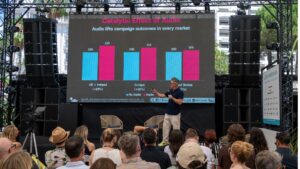
As reported by Brittney Rigby in Little Black Book, System1 studied more than 1,250 Effie Award campaign entries across 17 years. Campaigns that used audio consistently delivered stronger results, including:
- 75% higher profit
- 81% greater trust
- 81% higher price insensitivity
- 19% stronger customer acquisition
Apparently, sound matters. Who knew?
Well, we did. But it’s always nice when 17 years of data shows up to support the sales pitch.
What Counts as a Jingle?
The word “jingle” tends to conjure up a cheerful group of singers rhyming a brand name with something it never should’ve been rhymed with.
That can work. There’s a reason we’re all still haunted by commercial songs we heard when we were eight.
But a brand’s audio identity can also include a sonic logo, original music, a recurring melody, a signature voice, or a family of sounds used consistently across advertising, social media, podcasts, events, apps, and physical spaces.
The goal is simple: your audience should start recognizing you with their ears.
Most brands spend enormous amounts of time deciding how they look. Then, five minutes before the edit’s due, somebody asks, “oh, shit, what about music?”
That’s a missed opportunity.
Renting Versus Owning
We often compare licensed music to renting a house.
The right song can make a campaign feel instantly familiar, emotional, and culturally relevant. Then the license expires, the campaign ends, and most of the accumulated value stays with the song.
Original music gives the brand something it can keep building.
A strong musical idea can be adapted into commercials, social clips, podcasts, events, app sounds, hold music, and all the other places where brands unexpectedly make noise.
Each use reinforces the last one. Over time, the music starts doing some of the identification work normally assigned to the logo.
Nobody’s ever hummed a logo.
Consistency Beats Random Acts of Good Music
Plenty of brands use good music. Fewer use it consistently.
One campaign gets a famous licensed track. The next gets stock music. The app makes an unrelated ding. The podcast opens with something the intern found at 11:45 p.m.
Every piece may be perfectly fine on its own. Together, they sound like four different companies sharing a password.
A well-designed audio system creates a recognizable family resemblance without making everything identical. It can stretch across different audiences, formats, moods, and campaigns while still sounding like the same brand.
That consistency is where the value starts to compound.
Sound Shows Up Even When Nobody’s Looking
Audio also has one obvious advantage over visual branding: people don’t have to be looking at it.
They may be driving, cooking, exercising, working in another browser tab, or scrolling while pretending to listen during a meeting.
A distinctive sound can identify a brand before the logo appears, or without a logo appearing at all.
That doesn’t mean slapping the same three notes onto every conceivable piece of content. It means creating something distinctive enough to earn recognition and flexible enough to survive repeated use.
Fine, Get a Jingle
Ritson’s phrase is funny because it reduces a complicated strategic idea to five blunt words.
But the underlying advice is gold, Jerry.
Treat audio like a real brand asset. Think about it early. Make it distinctive. Own it when possible. Use it consistently. Give it enough creative attention that people won’t dread hearing it again.
And yes, possibly get a f**king jingle.
Have a brand, client, campaign, or upcoming project that could sound more memorable? Let’s brainstorm. No formal brief or singing audition required.